February 3, 2012

Who pays for What? Simi Valley Home Buyers & Home Sellers want to know

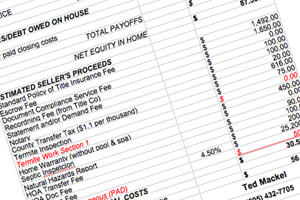
Estimated Costs to Sell Your Simi Valley HomeWhat is customary for a buyer and seller varies from state to state and in some states like California what is customary for buyers and sellers in Southern California may be different than in Northern California. The following list is what is generally customary for  Home Buyers and Sellers in the Simi Valley and Southern California area on purchases, not involving distressed properties (i.e. Short Sales and Foreclosures/Bank Owned):

The SELLER can GENERALLY be expected to pay:

  • Real Estate Commissions
  • Document preparation fee for deed
  • Documentary transfer Tax (deed tax stamps), if any
  • Pay off all loans in Seller’s name
  • Interest accrued to lender being paid off
  • Statement fees, re-conveyance fees and any prepayment penalties
  • Termite inspection (or according to contract)
  • Termite work (or according to contract)
  • Home warranty (or according to contract)
  • Any judgments, tax liens, etc., against the seller
  • Tax proration (for any taxes unpaid at the time of transfer title)
  • Unpaid homeowner’s dues
  • Recording charges to clear all document of record against the seller
  • Any bonds or assessments (or according to contract)
  • Any and all delinquent taxes
  • Natural Hazards Disclosure
  • Seller notary fees
  • Escrow fee (one half)
  • Repairs on deferred maintenance (if agreed to or according to contract)
  • Title insurance premium for owners policy
  • Homeowners Association transfer fee and documents fee
  • City transfer/conveyance tax (or recording contract)
  • Mandatory Government Compliance issues (i.e. Smoke detectors, Carbon-monoxide detector, water heater bracing, etc.)

The BUYER can GENERALLY be expected to pay:

  • Title insurance premium for lenders policy
  • Escrow fee (one half)
  • Document preparation (if applicable)
  • Buyer notary fees
  • Recording charges for all documents in buyers name
  • Tax proration (from date of acquisition)
  • Appraisal
  • Cost to run Credit Scores
  • All new loan charges (except those required by lender for seller to pay)
  • Interest Buy-down points (or according to contract)
  • Interest on new loan from date of funding to 30 days prior to first payment date
  • Assumptions/change of records fees for takeover of existing loan beneficiary statement fee for assumption of existing loan inspection fees (roofing, property inspection, sewer, pool, geological, etc.)
  • Buyer insurance premium for first year

Related Articles:

Simi Valley July 2011 Home Sales Surge on Volume Average Sale Price drops $57k

simi valley homes sold market updates for simi valley home sellers and buyersSee Simi Valley Homes For Sale under $300,000

The Simi Valley Real Estate Market is in the middle of a very interesting transition and while the traditional media and my industry tend to create reports that either cheer-lead or sell subscriptions; it would be prudent to really look at what has happened in July and a trend that started back in December of last year.

Sales of Simi Valley Single Family detached housing under $300,000 has been growing in volume.  Now, more than any other time since the bottom fell out of the real estate market in 2007, we are seeing prices drop and affordability rise with continued low interest rates.   In the Spring of 2009 we saw similar pricing, but investors rushed in and pushed pricing in this segment back up to the low $300,000 range.

What becomes even more interesting this time around is that of the 19 Simi Valley homes that sold under $300,000 in July 2011, 60% were purchased with conventional financing or cash with an average price of $278,000. Cash and conventional purchasers can be attributed to increased activity by investors looking for rental properties and properties in poor condition that could be restored and flipped.

What is causing Volumes to Surge? 

1. Prices/affordability 2. Low interest rates.

What is not happening on surging volumes?

Prices are not being run up.  Looking at Simi Valley Home Sales for July 2011 we can see that 84% of all sales were under $500,000 and that the top end over $900,000 had no sales for the month.  Sluggish sales over $500,000 contributes to the lower average sale price.

Tracking the average sale price does not necessarily mean that Simi Valley Home Owners have lost $57,000 in value, what it does indicate, is when you compare the average sale price each month over the course of time you can spot trends over the whole spectrum of price ranges, any major shifts between months as we are seeing between June (Simi Valley June Market Report) and July, helps us to look close at what is selling, who is buying and what are the conditions that are driving these sales.

Real Estate Markets are local,  traditional media tends to report regional and statewide Real Estate trends, which you can see don’t amount to much when we look at the activity for Simi Valley.

The local, State and Federal economic issues, $4.00 a gallon gasoline, employment opportunities have a huge influence on home buyers.  Additionally, the Foreclosure market, Short Sale Market and Loan Modification Market are still in the middle of their mountain of problems.

What is becoming clear from my experience with buyers in my car and looking at the trending data; buyers are very interested when pricing and condition are right, but they are unwilling to jack up the pricing (above market value) in bidding wars.

While this all may sound horrific to home sellers, this is all part or a greater stability that is forming.  Increasing volumes on lower prices is positive, what we don’t want to see is decreasing volumes and lower prices.

Simi Valley homes Sales for July 2011

Simi Valley homes Sales for July 2011 Graph

Asking for Closing Costs Could Cause Home Buyers To Over Pay For Their Purchase

Home Buyers leave money on the tableHome Buyers many times ask Home Sellers for concessions or assistance when they make an offer to purchase a home. The typical request from a home buyer is for closing costs, a home warranty, repairs or for the seller to include certain personal property items for sale. This article will focus on closing cost requests from home buyers.

The following information pertains to California real estate only. Real estate settlement and closing procedures vary from state to state, so if you are looking for information for real estate transactions in a state other than California, the information below may not apply to your situation.

As the Simi Valley housing market has lost value and sales have slowed, the requirements for buyers to get financing has become difficult at the same time. The Simi Valley real estate market has seen the most activity in homes selling under $450,000. The buyers in this price range typically have low down payment offers and do not have significant reserves or savings. The FHA loan program allows those buyers with limited resources to purchase homes with as little as 3 1/2% down. For Simi Valley this translates into approximately $8000-$15,000 minimum down payment needs; the FHA program helps these buyers get into homes.

Looking at Simi Valley homes selling for under $450,000, the typical closing costs associated with those home purchases can range in the $8000-$10,000 range. It has been a pretty common practice for buyers to write an offer asking the seller to concede up to 3% of the sale price to assist the buyer with these closing costs. While not all sellers have the ability to make this concession, the buyers will add this figure on top of their offer price so the seller will realize a net sales price closer to what is acceptable to the seller.

In 2010 the federal government changed the Good Faith Estimate (GFE) and tightened down regulations on this form to protect buyers from overpaying fees associated with obtaining financing. Once the buyer’s lender issues the GFE, the lender is bound by those numbers and has very few options to increase any of the figures on that statement. The 2010 GFE does allow for some minor adjustments, but overall the buyer can feel pretty good about the actual closing costs associated with their purchase and loan after receiving this document.   These new regulations with the GFE have created an issue in how buyers should ask for a closing cost credits from the sellers. If these credits are asked for without consideration of the new GFE requirements, the buyer can end up paying more for the property than they intended.

For example,

  1. The buyer asks for $10,000 credit toward closing costs in their offer to the seller.
  2. The seller is clear that they would like to receive no less than $400,000 for their property.
  3. The buyer’s offer is for $410,000 with the seller crediting back $10,000 toward the buyer’s closing costs.
  4. The seller accepts the offer and escrow is opened.
  5. The buyer now makes loan application with their lender.
  6. A GFE statement is issued within three days of the loan application outlining all the buyers costs.
  7. Those buyer costs total $8,000.
  8. The seller’s obligation is only $8,000 and the $2,000 difference is now realized by the seller in a net sale price of $402,000.
  9. The buyer just overpaid $2,000 more for the property than they originally intended to.

The example above outlines one of the problems Simi Valley home buyers may encounter when asking for closing costs to be credited by the sellers.

Some might say, ” when the buyer makes loan application, shouldn’t the lender set all the fees on the GFE statement to equal the $10,000?” The 2010 GFE was designed to outline  and identify the costs to obtain financing, so buyers could go out and compare the costs between different lenders. How would it be to the lender’s advantage to inflate the costs and fees; just to try and burn up a concession/credit from the seller? Also, why would anyone want to pay more for property or pay more for costs than they need to?

If you are a buyer who is considering asking for a seller concession in closing cost assistance, understand the ramifications of such requests. If reserves/savings are one of the driving issues into asking for this type of seller concession that is one thing, but if you are asking for the seller concession while you have the money to pay for these closing costs, consider the following:

  • Your property will be assessed for property taxes in the amount of the sales price. Is increasing the sales price worth paying additional property taxes over the course of time you own the property?
  • By offering more than the original listing price to cover your closing costs, remember you will be paying interest on the higher purchase loan amount for next 30 years (if your loan is amortized on a 30 year schedule). I’ve always felt that home buyers should deeply  reconsider (if possible) financing closing costs for 30 years. It’s does not make much since to pay interests on fees, since the first 20 years of the 30 year amortization schedule is weighted toward paying down the interest on the note.

Last, if you’re reading this article and you end up educating and instructing your real estate agent on these issues, ask yourself how well you’re being represented by an agent who’s not aware of these issues. If tour real estate agent is not aware of issues as important as the impact of closing costs on your pocketbook during negotiations of your home purchase; then what else are they unaware of that may leave your money on the table or put you at a disadvantage in negotiations?

My sellers will gladly accept the additional funds if your closing costs are overstated in your original offer.  Wouldn’t you feel better if you had an agent representing you trying as hard as they can to make sure you’re not leaving money on the table?  Call or text (805) 432-7705

Related Articles:

Simi Valley Home Sales Report for November 2010

Simi Valley home sales trends for November 2010 continued to match patterns we’ve seen over the last year. Volumes, pricing and most other factors remain unchanged month over month. While this stability is a good sign for the Simi Valley real estate market, most are still uneasy about future outlook of home sales.

Interest rates below 5% coupled with rates hitting their lowest point in November have not created any new stimulus for the Simi Valley real estate market. Looking at the Sales Volume chart below, you can see that over the past five years November has had a very common pattern except for 2007.

Simi Valley Homes Sold November 2010

The bulk of the activity in Simi Valley home sales still remains in the under 500,000 price range while homes above this price point fluctuate, the luxury markets are still selling at a very slow pace. Distressed properties including short sales and foreclosures are still negatively impacting the market and will continue throughout 2011.

Simi Valley Home Sales for November 2010 Current market conditions are still favorable for qualified Simi Valley home buyers as low interest rates and average home pricing afford good opportunity.  Looking at the Average Sale Price Graph below shows that average pricing seems to be holding steady without any major swings.  Much if this is related to the low interest rates and the rental payment comparison.  Renters looking to buy over the last few years are looking to keep monthly mortgage payments near what they would pay for rent and have been unwilling to enter the market without out a bid up mentality just because rates are the lowest we have seen in  a long time.

Simi Valley Average Sale Price for Single Family Homes

Purchases made in this market are a long term position.  Until the employment picture both on the State, Local and national levels recover overall home pricing and the Simi Valley real estate market will react on a similar pace as we have seen over the last couple years.

Trulia Voices Answers Understanding Short Sales Buyer’s Purchase Contract Issues

Trulia Real EstateShort Sale Buyer Contract deal points can make or break a short sale.  In this video blog I go over the Short Sale Addendum for a quick overview of the form and some commentary on how it can help protect the buyer in the transaction.

Make sure to read:  Simi Valley Short Sale Information here on HomeBuysBlog.com

Thanks for reading Simi Valley’s Premiere Real Estate Blog!

Author – Ted Mackel Simi Valley Real Estate Agent – Keller Williams Realty

Ted Mackel is a top producer at Keller Williams Realty Simi Valley,

specializing in Simi Valley Real Estate

(805) 432-7705

Simi Valley Home Buyers – FHA Premium Goes Up After Oct 4th

FHA Loans Simi Valley CaliforniaSimi Valley Home Buyers, if you are out shopping for a home and are going to use FHA financing it is important to make sure you get your FHA case number before October 4th, 2010 as the FHA Premium goes up after this date. John Yang independent mortgage broker and author of the Mortgage Video Blog explains how the increases will affect your monthly mortgage payment in this video.

Other articles on Lending:  Understanding the GFE Statement

Search for Homes in Simi Valley California Simi Valley Property Values

Thanks for reading Simi Valley’s Premiere Real Estate Blog!

Author – Ted Mackel Simi Valley Real Estate Agent – Keller Williams Realty

Ted Mackel is a top producer at Keller Williams Realty Simi Valley, specializing in Simi Valley Real Estate

(805) 432-7705

Simi Valley Homes For Sale Market Report for April 2010

Simi Valley homes for sale for the month of April 2010 had a slight uptick. The gain in average sales price and the slight gain in the total number of Simi Valley homes sold, is largely related to the federal tax credit that expired April 30. Effects from the federal tax credit will be  seen in the Home sales reported for May and June as part of the tax credit regulation required that Simi Valley home buyers have a property in escrow by April 30 but close their escrows by June 30.

Still looking at the charts below you can see that the action is in the lower end of the markets as this trend has continued over the last year.  Even-though the tax credits have given us a little positive momentum there is still quite a bit of softness in home pricing throughout Simi Valley. A property I sold in May, in the Simi Valley Oakridge Estates, dropped below 2003 prices. Another property I am working on in the Madera Hills Tract would’ve had higher offers last fall than what we’ve been seeing this last week.

What has become significant in the Simi Valley market is the number of short sales occurring. Most of the listing calls I’m getting at this point are coming from people who need to short sell their property. While I work with plenty of equity sellers, short sales create their own drag on the overall market.

Simi Valley homes for sale April 2010 mark the report

This is a Quick Graph of the Volume of Simi Valley Home Sales by Month since 2003 for single family detached homes. If you follow the chart you can see that the May, June and July figures all stay pretty close over the last couple years beginning after 2007. The news such as papers and TV reports on a much larger regional scale which lump the sales data for very large areas into one report. If you’re planning to buy or sell a home in Simi Valley, you need to know what’s going on in Simi Valley in order to come up with a strong strategy. Please bookmark or subscribe to this blog so you can see what is going on locally in Simi Valley.

 Simi Valley homes for sale year-to-date 2003 through 2010

Search for Homes in Simi Valley California Simi Valley Property Values


Thanks for reading Simi Valley’s Premiere Real Estate Blog!
Author – Ted Mackel Simi Valley Real Estate Agent – Keller Williams Realty
Ted Mackel is a top producer at Keller Williams Realty Simi Valley,
specializing in Simi Valley Real Estate
(805) 432-7705

Are Tax Credits Luring Simi Valley Home Buyers in a Cash for Clunkers Scheme?

Simi Valley Home buyer tax creditsFederal and California tax credits were created to lure home buyers into the market.  Simi Valley home buyers have a small window of opportunity to take advantage of both tax credits and double-dip the system. The federal first-time home buyer tax credit of $8000 is set to expire April 30. More specifically, home buyers qualify for this program will need to have a house under contract by April 30, 2010. They will need to have escrow close prior to June 30, 2010. At the same time, starting May 1, 2010  any escrows closing prior to June 30 will qualify for the California first-time home buyer tax credit of $10,000. While this credit is good through December 31st, 2010. The opportunity to double dip the system needs take place before June 30.

My main concern with these home buyer tax credit programs is that  Simi Valley home buyers (especially low down payment buyers) will rush to purchase a house and end up chasing  a tax credit cash for a clunker. Many of the properties for sale in Simi Valley currently are short sales and foreclosures. These properties typically have significant amounts of deferred maintenance and repair issues. Many times the repairs needed to restore these properties will far exceed any monies gained in tax credits. Keep in mind, at the California tax credit is spread out over three years and not given all at once.

My second concern is that these tax credits are really not creating any additional interest in the market. In fact  Simi Valley home sales volume and average home prices have dropped every month since  December 2009. I believe that the attractive affordability and low interest rates are driving the market currently and that sales would not suffer much if at all if the tax credits were to go away.

Those Simi Valley home buyers concerned that they may be missing a market can step back, relax and breathe a sigh of relief as the market is certainly near or at the bottom and will be for a long time before the market breaks through and start pushing out to a real recovery.

If you are a Simi Valley home buyer there is limited time to be able take  advantage of the double-dip but don’t get caught up in a frenzy and end up with a property  that will cost far more to fix up and what you will gain tax credit.

If you are a Simi Valley home seller, if your home is been on the market for a while and has not received any offers, now is the time to review your pricing strategies compared to other homes on the market that compete with your home and the homes that have sold in the last 120 days that compete with your home and  adjust your pricing to bring a buyer before April 30.


Search for Homes in Simi Valley California Simi Valley Property Values

Thanks for reading Simi Valley’s Premiere Real Estate Blog!

Author – Ted Mackel Simi Valley Real Estate Agent – Keller Williams Realty

Ted Mackel is a top producer at Keller Williams Realty Simi Valley,

specializing in Simi Valley Real Estate

(805) 432-7705

New RESPA Regulations to help drive out Bait & Switch Artists of the Morgage Industry

Shysters Stymied - New RESPA laws protect Home BuyersRESPA changes enacted January 16, 2010 will benefit  Simi Valley home buyers and help them understand the costs of their financing on the new good faith estimate (GFE) and HUD-1 settlement statements.

When shopping for a loan, the mortgage broker must give a good faith estimate to the client that outlines the costs of the loan. Prior to January 16, 2010 the GFE was a pretty general estimate and could fluctuate greatly between the time a home buyer identified a property to purchase and finally closed escrow. These lax regulations allowed unscrupulous mortgage brokers to easily bait and switch homebuyers into terms and fees they originally would have rejected. The “white hats” of the mortgage industry suffered under the old rules and this new regulation will allow the good guys to rise to the top.

Under the new regulation, the mortgage broker cannot give a GFE without there being a property. The new GFE is more detailed and has more specific rules. For example, mortgage brokers are allowed to average or estimate third-party costs such as inspections, appraisals or other testing.  At the close of escrow this figure is compared to the actual costs on the HUD-1.  There is a 10% difference allowance on these fees.

The new GFE and HUD-1 forms are designed to increase transparency to the Simi Valley home buyers by requiring mortgage brokers to show their yield spread premium as part of the origination fee. Most home buyers are not aware that in addition to the fees to the broker that were seen on the old forms, the broker earned additional money in the form of a yield spread premium. The yield spread premium was calculated on the interest rate spread between what the home buyer qualified at and what their final lock rate was at. The issue is not whether the broker is entitled to this fee, but rather that it must be disclosed.

There are some costs that cannot be altered on the form anymore which include the origination fee and the transfer taxes. Under the new regulation the original GFD and the final HUD-1 are compared at closing. If there are fluctuations in the fees outside of the limits above, the lender is held responsible for the difference.

If the discrepancy in these fees are over the 10%, then a change of circumstance affidavit needs to be signed at least three days before the loan can close. And a change in the interest rate would require new disclosures, GFE and truth in lending three days before closing.

I believe that the comparison of the GFE and the HUD-1 will help weed out the bad lenders in the industry, help the consumer understand and make more informed decisions about the costs of their loan and  reduce unnecessary costs and fees.

As the mortgage industry and our escrow officers learn how to work through this process, we should expect some delays in closings over the course of the next few months. Once everyone gets the hang of the new system, the consumers will benefit and our hard-working “white hat” mortgage brokers will be able to better serve home buyers.

Search for Homes in Simi Valley California Simi Valley Property Values

Thanks for reading Simi Valley’s Premiere Real Estate Blog!

Author – Ted Mackel Simi Valley Real Estate Agent – Keller Williams Realty

Ted Mackel is a top producer at Keller Williams Realty Simi Valley,

specializing in Simi Valley Real Estate

(805) 432-7705

Simi Valley Home Sales Report YTD – October 31, 2009

Simi Valley Detached Home Sales October 2008Simi Valley California home sales were down in October 2009. This is very interesting in that the market has been pushed in a positive direction by the first-time home buyers tax credit. In  September and October buyers knew that the tax credit was scheduled to expire on November 30, this should have reflected in an increase in sales. So far, November sales of single-family detached homes will be stronger than October. Looking closer at these November sales, the majority are in the entry-level price range making this increased activity for November closely tied to the tax credit.

With the extension of the tax credit moved to April 30, 2010, activity should remain brisk as buyers try to take advantage one final time.

Key factors including the affordability, low interest rates, and low inventory are keeping first-time buyers and the investor market very interested in home purchases. While the economy struggles both nationally, statewide and regionally; home buyers and home sellers should be aware that any recovery will most likely be drawn out over a course of years and fairly bumpy from here on out.

What this means for Simi Valley home sellers is that equity recovery is probably not around the corner, but the low inventory levels are helping sellers remain with a slightly stronger negotiating position over the buyers.

What this means for Simi Valley home buyers is that this high level of affordability will continue to create competition for the low supply of inventory.

You’ll notice below that I’m changing the format of my standard monthly market update for Simi Valley home sales. While the averages from the multiple listing service are interesting, if you’ve seen the charting I have posted over the last year, those averages are skewed as the lower end of the market is behaving much differently than the upper end.

Simi Valley single-family detached activity up through October 31, 2009 was as follows:

  • Total  Detached Homes Sold = 60
  • Average Sale Price = $460,845
  • Average Market Time = 82 days

Of these sold properties  – 11 were short sales and 12 were foreclosures. The remaining 38 were non-distressed sales.

  • Total  Detached Homes Active For Sale = 183

Of these active properties, 25 were short sales and 11 were foreclosures. The remaining 147 were non-distressed sales and an additional 270 homes were in escrow, with 173 of those Detached homes as short sales and 33 foreclosures.

An evident monthly trend is the extremely high ratio of  detached homes in escrow compared to available inventory and actual closed sales. This further points to the difficulty sellers are having with short sales. To understand why there is such a high failure rate on short sales  please see my article: What Is a Short Sale And Can I Short Sell My House

Simi Valley Town Homes & Condominiums are reacting better and this trend is most likely tied to the low interest rates, affordability  and the first-time home buyer tax credit.

  • Total Attached Homes Sold = 25
  • Average Sale Price = $277,907
  • Average Market Time = 93 days

Of these attached properties sold, 6 homes were short sales and 4 homes were foreclosures. The remaining 15 homes were non-distressed sales.

  • Total Attached Homes Active For Sale = 50

Of these Attached Active Properties, 15 were short sales and 2 were foreclosures. The remaining 33 were non-distressed sales and an additional 133  Attached Simi Valley homes in escrow with 63 as short sales and 12 as foreclosures.

Both in the attached and detached Simi Valley housing sectors these high numbers of short sales are very important to track. Month after month after month, large numbers of homes in escrow have been dominated by short sellers. An average of 80 single-family detached homes are closing escrow each month and 18 attached homes closing.  The large volume of nonperforming loans and bad assets are not dominating the low closing rates and seeing that less than 50% of the monthly sales are distressed properties, the low success rate in purging the market of the short sales, will keep any recovery slow.

For more information please see:

Search for Homes in Simi Valley California Simi Valley Property Values

Thanks for reading Simi Valley’s Premiere Real Estate Blog!

Author – Ted Mackel Simi Valley Real Estate Agent – Keller Williams Realty

Ted Mackel is a top producer at Keller Williams Realty Simi Valley,

specializing in Simi Valley Real Estate

(805) 432-7705