February 22, 2012

10 Mistakes Home Buyers Make with Simi Valley Short Sales

Simi Valley real estate and homes for saleSimi Valley Short Sales have been a big part of my business for the last couple of years.  These transactions are very complex and not every real estate agent is equipped to handle these transactions.  It is easy to get a seller to agree to list their home, but working with the Seller’s bank to get short sale approval is another story.  Many of the licensed agents that take short sales listings have no business doing so.  It is easy to attend a seminar and get a certification, but each and every short sale I have worked on is different with it’s own set of circumstances,  nothing can be substituted for hands on experience.

Understand that the representative at the bank has a typical work load of over 100 properties on their desk in various stages of the approval process.  My job is to keep my client’s file at the top of that stack and any time the bank representative throws a condition at us, we need to answer quickly and be able to state a case in support of my Seller.

A big part of my success is using a 3rd party negotiator on my team.  My negotiator is Real Estate Attorney and Licensed Broker, while he is acting only as a negotiator, the years of experience between the two of us has proven to a 100% track record in getting approvals.  We have completed traditional Short Sales and Short Sales under the HAFA program.

Your biggest obstacles as a buyer in a Short Sale are mostly going to be related to having unrealistic expectations.  Some will be generated on your own and the rest will be generated by the real estate agent representing you.

#1. Not understanding Market Value – You will write a Low Ball offer for several unsound reasons

  • First unsound reason – The bank already has written this property off at a loss, if they don’t take my offer they will lose even more money down the road.
  • Second unsound reason – They are getting more from me now then they will if they foreclose.
  • Third unsound reason – By the time I fix up the house after I buy it, I will have $50,000 into it, so my offer needs to be $50,000 below asking.

The bank has send appraisers out and paid other real estate agents for market opinions.  The Seller’s lender has a very good idea what the surrounding homes have sold for.  Additionally, I will price my Short Sale Listings at Market value and this is one of the direct reasons why my Short Sale Listings not only get approved, but they also close escrow successfully.   Typically the Seller’s Lender will come back and ask the buyer to come up with additional money if the Seller’s Lender thinks the offer is low compared to the market value.

#2.  Asking for Repairs – You or your agent will think that you can ask repairs after an inspection.  The seller is in a Short Sale because they are broke and out of money. They probably barely have enough money for a deposit on a rental when escrow closes and if your agent puts in your head that you can ask for repairs, you might want to look for a new agent before looking at other homes. Short Sale Lenders do not care that the water heater relief line does not exit to the outside of the home, they don’t care that the screens are broken or that the pool is green.  No they don’t care that the GFI’s are missing in the bathrooms. The Short Sale Lender has a bottom line number in their approval and if the buyer cant work with that number, then the approval will not be issued. The bank’s bottom line number and your low ball offer will not be compatible.  Seller is broke so that means you the buyer gets to pay for the repairs.

#3. Ask for Termite – Your agent tells you to ask for termite inspection and repair.  Once you put it in the contract now your lender is going to require the work be done, but remember the Seller’s bank isn’t going to pay for it and the Seller is broke so the only person left to pay, is you the buyer.

#4. Ask for Home Warranty – Once again the Seller’s bank isn’t going to pay for it and the Seller is broke so the only person left to pay, is you the buyer.

#5. FHA & VA financing - Try a Short Sale at your own risk, because FHA and VA will inspect the house and come up with a list of Lender required repairs.  See #2 and remember the Seller’s bank isn’t going to pay for it and the Seller is broke so the only person left to pay, is you the buyer. FHA & VA buyers have bought Short Sale properties, they just had to come out of pocket for Lender required conditions and repairs.

#6. Closing costs – Your Lender or Real Estate Agent told you to ask for $10,000 in closing costs. The Seller’s bank isn’t going to pay for your closing costs and the Seller is broke so, the only person left to pay for your closing costs is you the buyer.

#7. Unrealistic about time frames – Short Sales take a long time.  I have obtained approvals in as short as 3 weeks to 6 weeks, but the majority of the approvals are taking 90 to 120 days.  If you don’t know how to sit and wait for a long time with little information on the status, then you should not be writing offers of Short Sale properties.

#8. You have a home to sell – While I might be the only listing agent in Simi Valley to complete a Short Sale with a buyer who was selling their home and needed the proceeds from that sale to complete the purchase of my Short Sale;  I have not had any other bank agree to this.  The timing on these short sale approvals is so drawn out and consuming, it is very difficult to hold all the buyers together and wait for approval.  The representative for the Seller’s Lender know this and they do not approve offers that are contingent on the Buyer selling their property first.

#9. Attempt to flip or the old Double Escrow – You want to negotiate with the Seller’s Lender so you can turn around and find another buyer and make a quick profit.  My seller has no motivation or obligation to help you make a fast profit off their loss.  Keep in mind that the Seller’s Lender may have deficiency rights against may seller, so my seller would be crazy to take on larger future tax and deficiency obligations for your investment plans.  I wrote “Beware of Short Sale Flipping” which explains this better, but it can be illegal and FBI has been going after investors that are concealing their profit schemes from Short Sale Lenders.

#10. Not understanding THE SELLER IS BROKE and THE SELLER’S LENDER IS NOT GOING TO AGREE TO PAY FOR THINGS YOU DEMAND.  You should realize by now that there could be as much as $1,000 or even $2,500 of issues on a Short Sale property and if you are not prepared (as a buyer) to deal with those issues, you probably should not be writing offers on Simi Valley Short Sale properties.

The Seller’s Lender has a sale price they are willing to accept for the property that is going to be very close to market value.  The Seller’s Lender will try to get the buyer to pay over market value.  The Seller’s lender is going to try every possible thing they can to to minimize the the costs to sell the property which is why buyer demands are not the concern of the Short Sale Lender.

To understand the short sale process better please read

California Foreclosure Time Frames – How much time do you have?

 California Foreclosure Time Frames, How Much Time Do You Have?California foreclosure time frames. How much time do you have before foreclosure? The following information will outline issues you should be concerned with if you are facing foreclosure in the state of California. If you have any questions, please use the comments below, I’ll be happy to help where I can.

In the state of California, loans against real property are secured typically by a Deed of Trust. This benefits both the consumer and the lender with a very specific process for the lender to recover the property in the event the borrower defaults on their obligation. This also protects the consumer (borrower) with a set procedure and rights to redeem or cure their loan if and when the borrower default. This process is consumer friendly as it limits the recourse/deficiency rights of the lender.

Here are some the terms be familiar with:

Beneficiary – the lender.
Trustor - the borrower.
Trustee - third-party that holds the title in trust until the loan is repaid.
Power of Sale Clause - contained in most California real property loan documents that gives the Trustee the ability to recover or sell the property for the Beneficiary if the Trustor defaults.
Non-judicial foreclosure – the Power of Sale Clause in gives a Trustee the ability to recover or sell the property without going to court.
Purchase money – money borrowed to purchase real property which is secured by Deed of Trust.
One Action Rule – the California Deed of Trust system and its Non-judicial Foreclosure proceedings create a One Action Rule on most properties, meaning that once the Trustee Sale occurs the beneficiary has no deficiency rights against the Trustor. This is typically true for Purchase Money Trust Deeds. Refinance and home equity line of credit (HELOC) money secured by deeds of trust typically contain deficiency rights against the Trustor.

I’m going to give the typical outline and some time lines of a California foreclosure; however because of  the current market & economic conditions (2010), the banking system is not following the exact procedures as they try to deal with large inventory of non-performing loans. The Federal government and the banking industry is trying everything in their power not to flood the market with foreclosed inventory, so we are seeing delayed foreclosure proceedings. If you are a borrower facing foreclosure, do not count on delays even if you hear stories of other borrowers staying in homes for a year without making payments. Once the Notice of Default is filed, you could lose your home if you do not take the necessary steps to cure the default and/or protect your rights.

Typically when the borrower defaults on their payments, the lender will wait till the borrower is approximately 90 – 120 days behind in payments before starting the foreclosure process. There is nothing stopping them from starting at 60 days or at 31 days, however I believe because the ability for the borrowers to cure the default and the cost for the lender to foreclose and sell the property; lenders typically try to see if they can get the borrowers to catch up before starting the foreclosure process. The lenders are not in the property management business or property ownership business, they are far better off if they can get the borrower to cure the default and continue making payments.

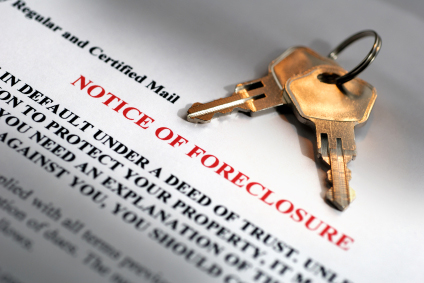
Once the lender has determined that they must move forward the foreclosure process, the first step is that the lender contacts Trustee and instructs the Trustee to issue a Notice of Default. The default is recorded, mailed and sent certified mail to the borrower. This starts a 90 day period in which the borrower can bring the loan current and stop the foreclosure proceedings. To bring the loan current, the Notice of Default typically contains past due amounts, penalties, late fees and legal fees. At the end of the 90 day period, a 20 day notice of sale is recorded, mail to the borrower, posted on the property and is to be published to notify the general public of the upcoming sale auction. The sale cannot occur until 21 days after the publication. This is why when you ask most people how long does the foreclosure process take, figure approximately 120 days rather than 110 days. I guess if the trustee and the lender is organized enough, they can coordinate the publication to occur quicker but that would be the exception rather than what would happen in the normal course of business. In either case if you have defaulted on your loan, any mail or notices delivered to you or posted to discuss your loan being in default or your property being sold should be taken very seriously. I would be careful in ignoring certified mail as you may need the information in those notices to protect yourself.

The notice of sale will contain the date, time and location of the trustee sale, which is typically on the steps of the county courthouse where the property is located. The property will be sold highest bidder which includes the lender.

So this leads us to the question, you’re in trouble and you’re pretty sure you can’t save your home so when do you have to move out? The short answer is if you do not resist, approximately six months from the day the Notice of Default is filed. This includes the approximate 120 days it takes for the lender to get the property sold at the county courthouse plus an additional 60 days before the sheriff shows up and locks you out.

IMPORTANT: IF YOU ARE FACING FORECLOSURE, a Short Sale may be an option to slow down or pause the foreclosure process.  Call me to discuss this option (805)432-7705.  I have completed several Short Sales where we stopped the foreclosure with only two weeks before the sale date.  This is not easy and is not guaranteed to work for every situation, but it can be worth a try.  Please don’t wait till there is only a few weeks left.  If you have a Notice of Default filed against your property and you cannot come up with the money to paid off the NOD, it’s time to give me a call.   I have written several articles on the Short Sale process under the Short Sales category of this Blog.  Time is an important factor with Foreclosure and Short Sales, feel free to call, your situation will be kept confidential. Several property owners I have helped did not want a for sale sign in their yard as they did not want friends and neighbors aware of their situation, we were able to sell their home and work through the process.

This above post is informational only.  THIS  IS NOT INTENDED TO BE LEGAL or TAX ADVICE. Each situation can vary and I strongly urge you to seek the advice of an attorney and tax professional to protect your rights. Keller Williams Exclusive Properties & Ted Mackel is not associated with the government, and our service is not approved by the government or your lender. Even if you accept an offer and use our service, your lender may not agree to change your loan. If you stop paying your mortgage, you could lose your home and damage your credit rating.


Thanks for reading Simi Valley’s Premiere Real Estate Blog!

Author – Ted Mackel Simi Valley Real Estate Agent – Keller Williams Realty

Ted Mackel is a top producer at Keller Williams Realty Simi Valley,

specializing in Simi Valley Real Estate

(805) 432-7705

What is REO?

What is REO? Here’s one for the longtail and a sort of WIKI entry to my BLOG!!!

In any business it is hard not to slip into the industry vernacular and forget that our audience may not really be following. REO is an acronym for Real Estate Owned. Here in Simi Valley and Moorpark an REO property falls under the California process of foreclosure. California is a Trust Deed state. The term mortgage is a more universal term like Kleenex or Xerox for Californians.

When a person borrows money against a property the Loan is made and secured against the property with an instrument known as a Deed of Trust. The Deed of Trust has three partys. The Lender (Beneficiary), The Borrower (Trustor) and the Trustee – an entity or person who holds the Title to the property until the Loan (secured by the Deed of Trust) is paid.

In the event that the Trustor defaults on the Loan, the Trustee is vested with the right (power to sell) to foreclose (non Judicially) on the property with in the parameters allowed by the state of California. At the time the Trustee is entitled to set the date of sale, public notice is given. The minimum bid is set at the amount owed on the property plus payments in arrears, plus costs. This minimum amount is usually more that the market value of the property so the Beneficiary ends up with the property and then will either hire a real estate broker or private auction company to sell the property. Once the Beneficiary takes title to the property, the property is now known as an REO.